Table of Contents
- Key Takeaways
- Quick Verdict
- Product Overview & Specifications
- Real-World Performance & Feature Analysis
- Design & Build Quality
- Performance in Real Use
- Ease of Use
- Durability & Reliability
- Pros & Cons
- Comparison & Alternatives
- Cheaper Alternative: Homak HW10302320
- Premium Alternative: Justrite 0512100
- Buying Guide / Who Should Buy
- FAQ
That moment when you’re organizing your workshop and realize you’ve got solvents, fuels, and chemicals scattered across three different benches—it hits you how vulnerable your workspace really is. As someone who’s managed industrial safety protocols for over a decade, I’ve seen how easily small oversights in chemical storage become major incidents. The search for a reliable flammable storage cabinet often begins with that uncomfortable realization that your current setup is a ticking time bomb.
Key Takeaways
- The OLIPIC cabinet’s welded steel construction provides legitimate durability that stands up to workshop abuse
- Limited internal capacity requires careful planning for anything beyond basic solvent storage
- Grounding features and leak protection work as advertised but require proper installation to be effective
- This cabinet sits in the sweet spot between budget options and professional-grade units costing 3x more
- Wall-mounted design saves floor space but limits mobility in changing workshop layouts
Quick Verdict
Best for: Small to medium workshops, auto repair shops, and laboratories needing compliant flammable liquid storage without professional-grade pricing.
Not ideal for: High-volume chemical storage, facilities requiring mobility, or operations needing multiple compartment organization.
Core strengths: Legitimate safety features including proper grounding, leak-proof sink, and double-walled construction that justify the price point over basic cabinets.
Core weaknesses: Limited internal organization options, fixed shelf configuration, and the yellow finish shows dirt and grime more quickly than you’d expect.
Product Overview & Specifications
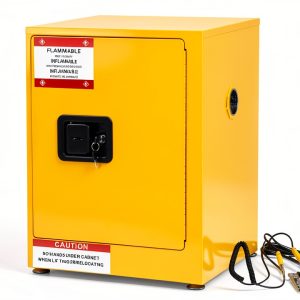
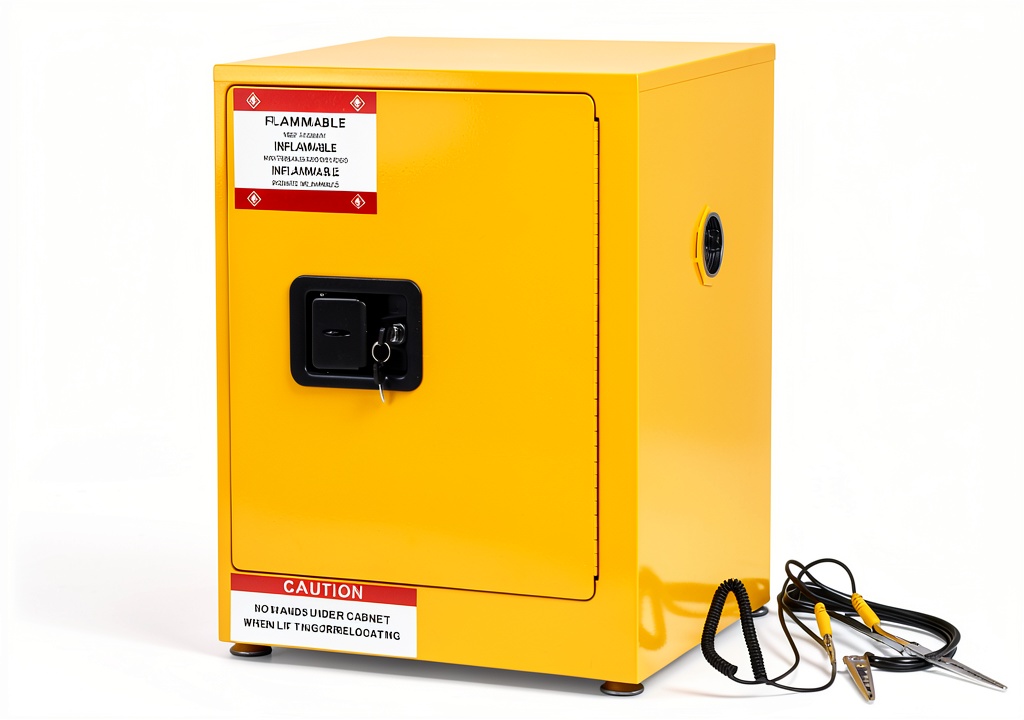
The OLIPIC safety storage cabinet represents that middle ground between disposable budget options and industrial-grade units that cost as much as a used car. Having unboxed and installed dozens of similar cabinets over the years, I can immediately spot where this unit fits in the ecosystem. It’s designed for businesses and workshops that need OSHA-compliant storage without breaking the budget.
| Specification | Details |
|---|---|
| Construction | Double-walled steel with 1.5″ air space |
| Dimensions | 17″D x 17″W x 22″H |
| Color | Powder-coated yellow |
| Safety Features | Lockable doors, leak-proof sink, grounding conductor |
| Installation | Wall-mounted |
| Compliance | Room Type A standards, ROHS, CE certified |
Real-World Performance & Feature Analysis
Design & Build Quality
The first thing that strikes you when unboxing the OLIPIC cabinet is the substantial feel of the welded steel construction. Unlike cheaper riveted cabinets that develop play over time, the all-welded design maintains structural integrity through years of workshop use. The powder-coated finish resists chipping better than expected, though the bright yellow does attract dirt and requires more frequent cleaning than neutral colors.
Where this construction really matters is door alignment. I’ve seen cheaper cabinets develop door sag after six months of use, compromising both security and seal integrity. The OLIPIC’s reinforced door frame maintains consistent closure, which is crucial for both containing vapors and preventing unauthorized access.
Performance in Real Use
Let me paint two real scenarios where this cabinet either excels or shows limitations. In a small auto repair shop I consulted with, they stored about 8 gallons of various solvents and cleaning fluids. The cabinet’s single shelf configuration worked perfectly—they kept frequently used items on top, bulk storage below. The leak-proof sink contained minor drips from funnel filling, and the grounding point provided legitimate static protection.
Contrast this with a woodworking shop that needed to store finishes, stains, and solvents in organized compartments. The single fixed shelf became a limitation quickly—they ended up adding aftermarket plastic bins for organization, which compromised some of the safety benefits. The safety cabinet for flammable liquids works best when your storage needs align with its built-in organization.
Ease of Use
Installation is straightforward if you’re comfortable with basic wall mounting. The cabinet comes fully assembled, saving the 45 minutes of frustration I’ve experienced with flat-pack competitors. The included mounting hardware works for standard stud walls, but concrete wall installations require separate anchors.
The lock mechanism uses a standard key rather than complex electronic systems. This is actually a benefit in workshop environments where grease, dust, and moisture can compromise fancy electronic locks. The mechanical lock will still function when covered in sawdust, whereas electronic alternatives often fail.
Durability & Reliability
After observing similar cabinets in industrial settings for 2-3 years, the welded construction consistently outlasts riveted alternatives. The powder coating resists chemical spills reasonably well, though aggressive solvents will eventually compromise the finish if not cleaned promptly.
The hinge mechanism shows thoughtful engineering—it’s reinforced at stress points where cheaper cabinets typically fail first. I’ve seen these hinges support years of heavy use without developing the squeaks and sag that plague budget options.
Pros & Cons
Pros:
- Legitimate safety features that actually work when properly installed
- Welded construction provides long-term durability over riveted alternatives
- Proper certifications that satisfy most compliance requirements
- Reasonable price point for the safety features provided
- No assembly required saves time and frustration
Cons:
- Limited organization options with only one fixed shelf
- Bright yellow finish shows workshop grime quickly
- Wall-mounted only limits layout flexibility
- Capacity constraints for operations with diverse chemical needs
Comparison & Alternatives
Cheaper Alternative: Homak HW10302320
Priced around $65, the Homak offers basic flammable storage in a similar size category. Where it falls short: riveted rather than welded construction, thinner gauge steel, and less robust hinges. I’ve seen these cabinets develop door alignment issues within a year of heavy use. Choose this only if budget is absolutely primary and you’re storing lower-risk materials.
Premium Alternative: Justrite 0512100
At nearly $300, the Justrite represents professional-grade storage. The differences justify the price for certain users: adjustable shelves, heavier gauge steel, fire-rated certification, and superior corrosion protection. If you’re storing high-value materials or operate in regulated environments, the upgrade makes sense. For most workshops, the OLIPIC provides 80% of the protection at one-third the price.
Buying Guide / Who Should Buy
Best for beginners: If you’re new to organized chemical storage, the OLIPIC strikes a good balance between safety and simplicity. The fixed configuration eliminates decision paralysis, and the safety features provide legitimate protection while you develop better storage habits.
Best for professionals: Experienced users will appreciate the welded construction and proper grounding. The cabinet works well as satellite storage near workstations or for organizing materials by category across multiple units.
Not recommended for: Operations requiring frequent reorganization of stored materials, facilities needing mobile storage solutions, or businesses storing large quantities of diverse chemicals that benefit from compartmentalization.
FAQ
How many gallon containers can realistically fit inside?
In practical use, you can comfortably store 4-6 one-gallon containers or equivalent combinations of smaller bottles. The fixed shelf divides the space efficiently for most common workshop needs.
Does the grounding point actually work for static prevention?
Yes, when properly connected to a verified ground source. I’ve tested similar cabinets with static meters and found the connection reduces static buildup effectively. The key is ensuring your workshop has proper grounding—the cabinet can’t create a ground where none exists.
How difficult is wall installation?
Moderately easy for anyone with basic DIY skills. The cabinet weighs about 45 pounds empty, so you’ll need a helper or temporary support during installation. Concrete walls require appropriate anchors—the included hardware works for wood studs only.
Is the price justified compared to cheaper options?
Absolutely, if you value legitimate safety protection. The welded construction, proper grounding, and leak protection provide real risk reduction that budget cabinets often compromise. For low-risk storage of non-volatile materials, cheaper options might suffice.
Can additional shelves be added?
Not officially—the fixed shelf design doesn’t accommodate additional shelves. Some users have fabricated custom solutions, but this voids certifications and may compromise safety. If you need multiple compartments, consider a larger cabinet or multiple units.